TL;DR Stop configuring devices manually. Define your network once, generate configs automatically and validate before deployment.
Introduction
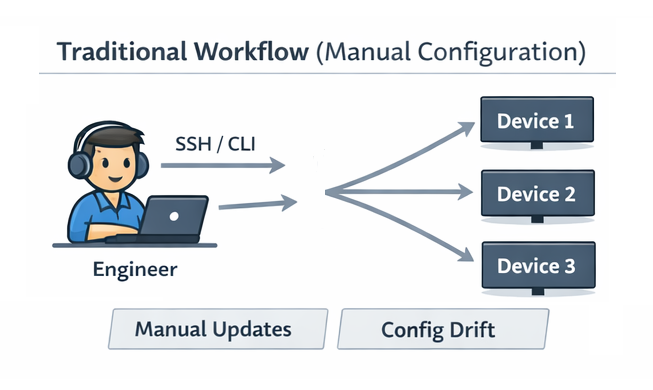
Managing network configurations has traditionally been a manual, device-by-device process. Engineers connect to each device, apply configuration changes, verify them, and repeat.
This works — until it doesn’t.
As networks grow, this approach becomes slow, inconsistent and difficult to scale.
In this article, we’ll walk through a very simple demonstration of treating network configuration as code. The goal is not to build a production-ready system, but to illustrate the core principles and why they matter.
Repository for this demo : https://github.com/ppklau/network_automation/tree/main/learning/network_as_code
The Problem We’re Trying to Solve
Traditional workflows introduce several challenges:
Manual, Device-by-Device Configuration
Engineers must connect to each device individually (SSH, console, etc.), apply changes and verify them.
- Time-consuming
- Repetitive
- Difficult to track
Configuration Drift
Over time, devices drift away from their intended state:
- Emergency fixes applied inconsistently
- Changes not documented
- Devices no longer match design
Human Error
Manual work inevitably leads to:
- Typos
- Missing commands
- Inconsistent configurations across devices
Does Not Scale
What works for:
- 5 devices → manageable
- 50 devices → painful
- 500 devices → unsustainable
A Better Approach: Network Configuration as Code
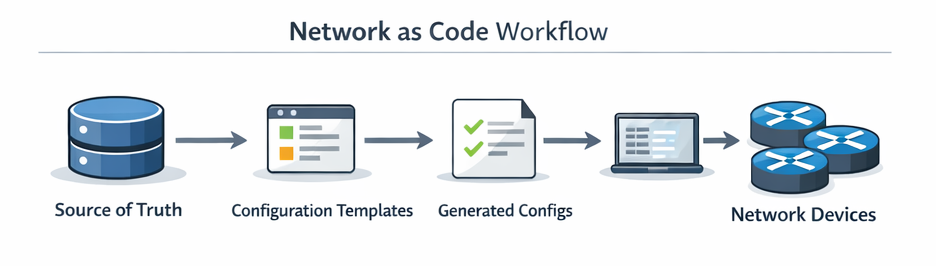
Instead of configuring devices directly, we define configurations in code and generate device-specific configurations automatically.
This approach is built on two simple ideas.
1. Single Source of Truth
All network data lives in one place.
This could be:
- YAML
- JSON
- A database
It defines things like:
- Hostnames
- IP addresses
- VLANs
- Interfaces
Key Idea : The source of truth is the only place you edit network intent.
2. Templates for Configuration Generation
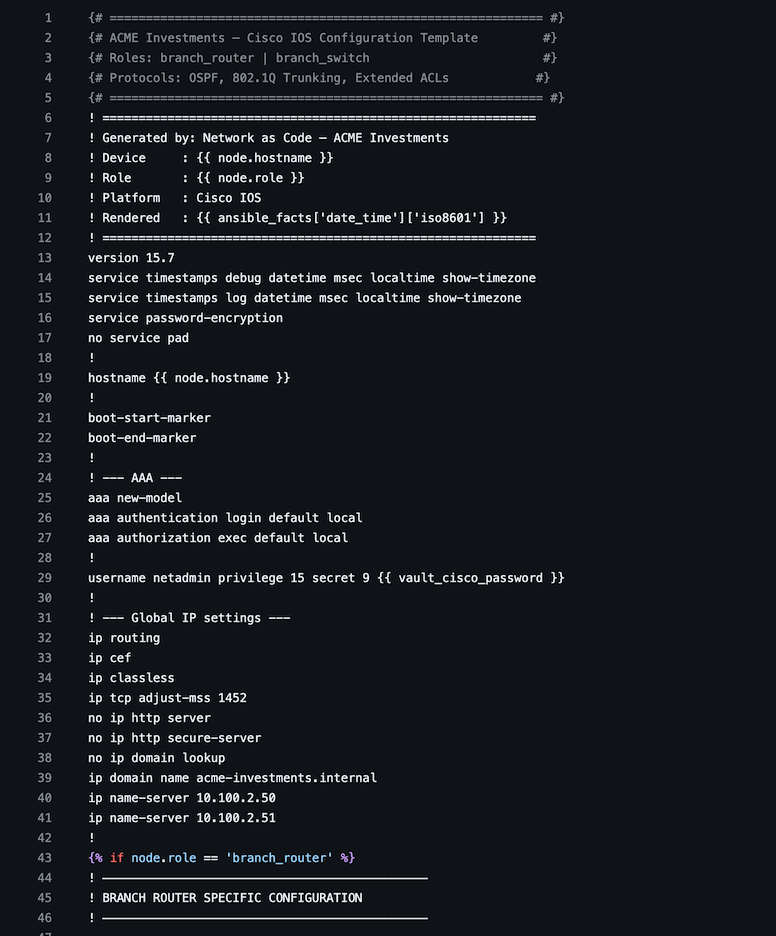
We use templates (e.g., Jinja2) to turn data into device configurations.
This gives us:
- Consistency across devices
- Repeatability
- Easier updates (change data → regenerate configs)
A Simple Demo
This repository (https://github.com/ppklau/network_automation/tree/main/learning/network_as_code) demonstrates the basic workflow:
- Define network data (source of truth)
- Use templates to generate configurations
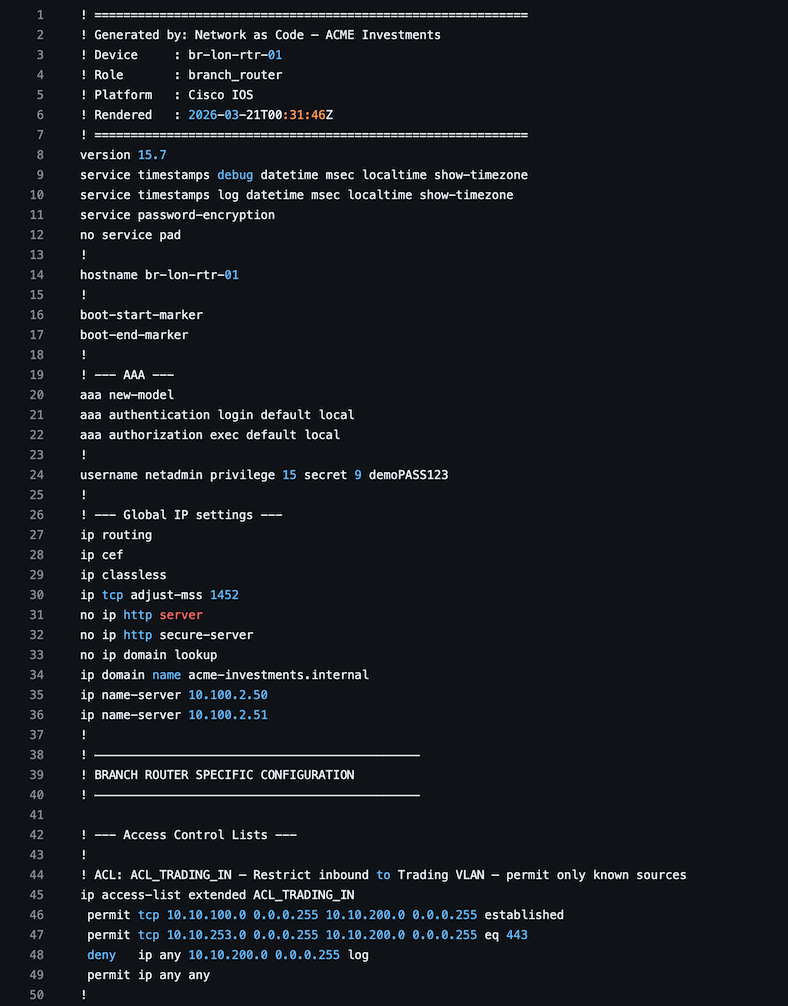
- Output device configs automatically
Note : This is intentionally minimal. The goal is to illustrate the concept — not build a full production system. The source of truth is just a YAML file to keep things simple and understandable, more scalable solutions need to be deployed for anything beyond lab or development.
Repository Structure
network_as_code/
├── ansible.cfg                   # Ansible runtime configuration
├── generate_configs.yml          # Master playbook
├── inventory/
│   ├── inventory.yml             # Ansible host groups & connection vars
│   └── nodes.yml                 # Source of Truth – devices, IPs, VLANs, VRFs
├── templates/
│   ├── arista_eos.j2             # Arista EOS template (VXLAN/MLAG/eBGP-EVPN)
│   └── cisco_ios.j2              # Cisco IOS template (OSPF/ACLs/802.1Q)
├── build/                        # Generated configs (git-ignored in prod)
│   ├── datacenter/
│   │   ├── spine/
│   │   ├── leaf/
│   │   └── border/
│   └── branch/
│       └── london/
└── README.md
Sample Configuration Template
Sample Generated Configuration
Built-in Benefits: Linting and Testing
Once configuration is treated as code, we unlock powerful capabilities.
Linting
We can automatically check:
- Syntax correctness
- Style consistency
- Policy compliance
Before anything touches a real device.
Automated Testing (e.g., Batfish)
We can validate the network before deployment:
- Reachability checks
- Routing validation
- Misconfiguration detection
Shift Left : Catch issues early — before they become outages.
Applying Configuration Safely
Generating configs is only part of the story — the next step is applying them.
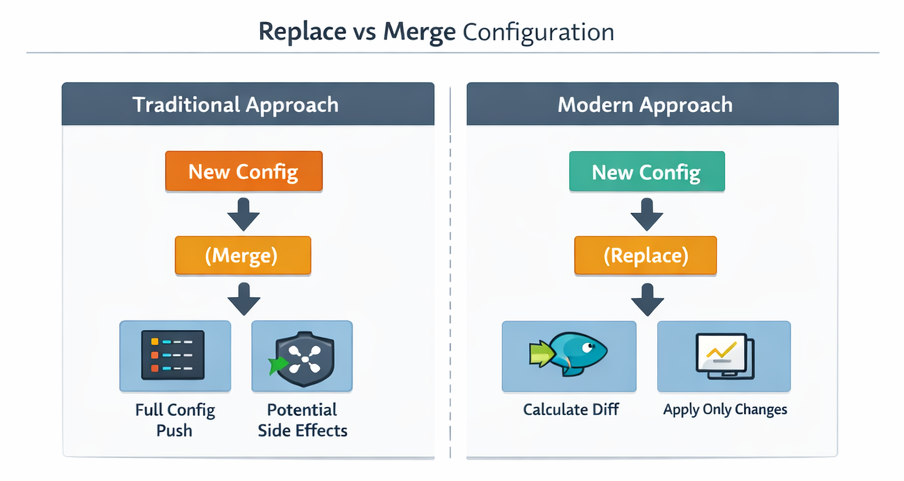
Modern network devices increasingly support a “replace” configuration model.
Replace vs Traditional Approach
Instead of merging line-by-line:
- The device calculates an internal diff
- Only required changes are applied
- Unnecessary changes are avoided
Why This Matters
- Reduces service disruption
- Avoids unintended side effects
- Makes deployments predictable
Key Insight : This allows us to treat network devices more like modern services:
- Apply a new configuration
- Let the system calculate the difference
- Update safely and consistently
- no configuration drift
Where This Leads
This simple demo is just the beginning.
Next steps typically include:
- A Single Source of Truth that scales
- Adding validation pipelines (lint + testing)
- Integrating CI/CD workflows
- Automating deployment
- Implementing rollback strategies
Conclusion
Network configuration as code directly addresses the core challenges of traditional network management:
- Eliminates repetitive manual work
- Reduces configuration drift
- Minimizes human error
- Scales with your infrastructure
By combining:
- A single source of truth
- Templates for generation
- Automated validation
we bring modern software practices into network engineering.