In the previous article we explored how organisations can assess their NetDevOps maturity through a structured health assessment. That exercise helps teams understand where their network engineering practices stand today and highlights areas that require improvement.
But an assessment alone does not improve capability.
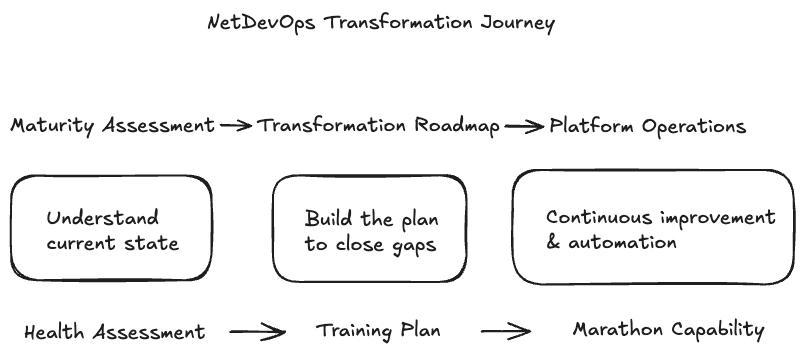
Consider a medical check-up. A health assessment may reveal that you are not as fit as you would like to be for your aspiration to run a marathon. But understanding your current condition does not prepare you for the race. To reach that goal you need a training plan that gradually builds endurance, strength and discipline.
NetDevOps transformation works the same way.
The maturity assessment provides a snapshot of where your organisation is today. The next step is creating a transformation roadmap – a structured plan that helps your organisation build the capabilities required to operate modern networks more reliably, efficiently and at scale.
Defining the Target State
Before building a roadmap, it is important to define what success looks like.
The target state should not be defined by specific tools but by the capabilities required to operate the network effectively. Examples include:
- version-controlled network configurations
- automated configuration deployment
- automated validation and testing
- CI/CD pipelines for network changes
- telemetry-driven operations
The roadmap should therefore focus on building capabilities, not simply introducing tools. Tools change quickly but operational capabilities create lasting improvements.
Transformation Is More Than Technology
One of the most common mistakes in automation initiatives is focusing almost entirely on technology.
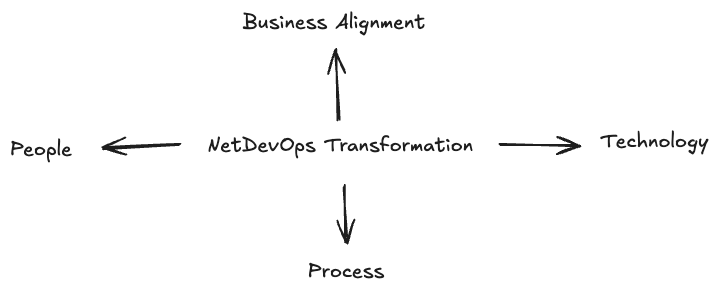
Successful transformation requires alignment across multiple dimensions:
Transformation = Technology + Process + People + Business Alignment
Introducing new platforms without addressing organisational structure, operating processes and cultural change often results in fragmented automation efforts that struggle to scale.
Designing a roadmap therefore requires thinking beyond tooling. The organisation itself must evolve alongside the technology it adopts.
Key Dimensions for Designing the Roadmap
A sustainable NetDevOps transformation requires coordinated progress across several areas.
People and Skills
As NetDevOps capabilities evolve, so do the required skillsets within engineering teams.
Engineers increasingly develop capabilities in areas such as:
- automation frameworks
- scripting and programming
- CI/CD pipelines
- automated testing
- observability and telemetry
At the same time, deep networking expertise remains essential. Automation does not replace networking knowledge; it amplifies the impact of engineers who understand the systems they are automating.
Automation also changes how teams work. The automation platform itself becomes an internal product that requires engineering effort to maintain and improve.
Important questions include:
- Who owns and maintains the automation platform?
- How do existing roles evolve as automation becomes more prevalent?
- How much engineering capacity is required to support the platform?
Many organisations address this by introducing platform responsibilities that ensure shared automation capabilities remain reliable while allowing engineering teams to focus on delivering operational workflows.
Platform and Tooling Strategy
Automation platforms themselves require supporting infrastructure and architectural decisions.
Organisations must decide how these capabilities will be deployed and operated. Options may include:
- traditional server deployments
- containerised platforms
- Kubernetes-based environments
- cloud-hosted infrastructure
Each option introduces different trade-offs in terms of scalability, operational complexity and cost.
Closely related to this is the buy versus build decision.
Building everything internally is rarely efficient. Every internally developed component introduces ongoing costs in development effort, maintenance and operational support.
In many cases, the most valuable internal work lies in building integrations between systems, rather than recreating functionality that already exists.
When evaluating tools or platforms, organisations should consider the total cost of ownership, including licensing, operational overhead, development effort and required expertise.
Culture and Organisational Change
Technology transformation also requires cultural change.
Common organisational challenges include:
- resistance to change
- siloed teams
- unclear ownership
- blame-oriented operational cultures
Successful NetDevOps initiatives typically encourage collaboration, shared ownership and continuous improvement.
Practices inspired by DevOps and Site Reliability Engineering (SRE) — such as post-incident reviews, cross-team collaboration and automation-first thinking — help create an environment where engineers can experiment and improve systems safely.
Decision Making and Architecture Governance
Large transformation initiatives often stall when organisations struggle to make architectural decisions.
Clear and transparent decision-making processes help maintain progress.
One useful practice is the use of Architecture Decision Records (ADR). ADRs document the reasoning behind architectural choices, allowing teams to move forward while preserving context for future engineers.
By recording decisions and their rationale, organisations can avoid repeated debates and maintain momentum without losing institutional knowledge.
Stakeholder Alignment and Leadership Support
Sustained leadership support is critical for any transformation initiative.
One of the most effective ways to maintain that support is by demonstrating continuous progress. Delivering incremental improvements — rather than waiting for large milestones — helps build confidence across the organisation.
Small but visible improvements often create strong internal advocates and help sustain momentum.
Building the Transformation Roadmap
Once these considerations are understood, the roadmap itself can take shape.
A practical approach typically includes several steps:
- Identify capability gaps from the maturity assessment
- Prioritise high-impact use cases
- Define phased transformation milestones
- Allocate resources and responsibilities
- Establish measurable outcomes
Like a marathon training plan, the roadmap should balance ambition with practicality. Sustainable progress comes from consistent improvement rather than sudden bursts of activity.
Example NetDevOps Transformation Roadmap
The following simplified roadmap illustrates how a transformation journey might be structured.
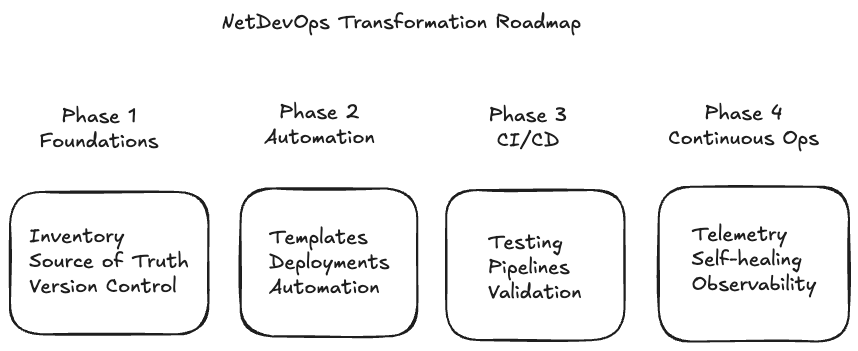
Every organisation will adapt its roadmap based on its current maturity, priorities and operational constraints.
Measuring Progress
Training for a marathon requires consistent measurement of progress. The same principle applies to transformation initiatives.
Useful indicators may include:
- percentage of network changes delivered through automation
- deployment frequency
- change failure rate
- lead time for network changes
Tracking these metrics helps demonstrate measurable improvements and maintain alignment with leadership objectives.
Plans Will Evolve
No training plan remains static.
As runners build endurance and strength, their training schedules evolve. Similarly, transformation roadmaps change as organisations gain experience, discover new challenges and refine their goals.
Maintaining clear communication across stakeholders ensures that the roadmap continues to support the organisation’s long-term objectives.
Conclusion
A maturity assessment provides valuable insight into the current state of network engineering practices. But like a health assessment, it is only the starting point.
Real progress requires a structured transformation roadmap — a training plan that gradually builds the capabilities required to operate modern network infrastructure effectively.
By considering technology, process, people, and business alignment together, organisations can design a roadmap that delivers sustainable improvements rather than isolated automation projects.
And with the right training plan in place, the marathon becomes achievable.